U.S. salary & occupation data · BLS sourcedSer. 2026
How to BecomeSOC 29-2032
How to Become an Ultrasound Tech: Education, Certification, Pay
Becoming a diagnostic medical sonographer typically takes an associate degree plus certification. Here is the real path, timeline, and BLS pay data.
Last updated 2026-08-03 · Wage data: May 2024 (BLS)
Key figures
Diagnostic medical sonographers ("ultrasound techs") typically need at least an associate degree or postsecondary certificate from an accredited program, plus professional certification most employers expect even where not legally required. BLS reports a median annual salary of $89,340 in May 2024 and projects 13% employment growth through 2034.
Diagnostic Medical Sonographers: Annual Wage by Percentile (May 2024, U.S. national)
Enter your own pay as a diagnostic medical sonographers, either annual or hourly, and this tool locates it against the BLS wage percentiles above.
If you moved industries
These are published industry medians for diagnostic medical sonographers, not a personalized prediction for your salary.
BLS publishes a median hourly wage of $42.95 for this occupation; that real figure is used as the hourly reference. Your own hourly-to-annual conversion assumes 2,080 hours/year (BLS full-time convention).
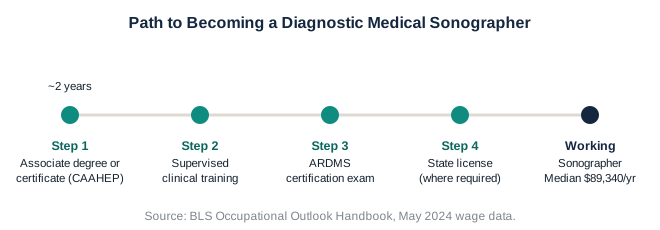
The Bureau of Labor Statistics states that diagnostic medical sonographers typically need "at least an associate's degree or a postsecondary certificate." In practice, most entrants complete a two-year associate degree program in diagnostic medical sonography, though postsecondary certificate programs (often for people who already hold a healthcare credential, such as a nursing degree or radiologic technology background) can be shorter.
These programs combine classroom instruction in anatomy, medical terminology, and applied physics of ultrasound imaging with a substantial clinical component, where students perform supervised scans in a hospital or clinic setting before graduating. Choosing a program accredited by the Commission on Accreditation of Allied Health Education Programs (CAAHEP) matters in practice: many employers and certifying bodies require or strongly prefer a CAAHEP-accredited program, and skipping that step can limit job options later even if the coursework itself was comparable.
Certification and licensing
BLS notes that some states require sonographers to hold a state license, and that employers commonly prefer candidates with professional certification even in states where it is not legally mandated. The most widely recognized certifying body is the American Registry for Diagnostic Medical Sonography (ARDMS), which offers credentials across specialty areas (abdominal, OB/GYN, vascular, cardiac, and others) via a combination of education/experience requirements and a certification exam.
Most programs and employers also expect sonographers to hold current Basic Life Support (BLS/CPR) certification, since the role involves direct patient contact and occasional emergency situations during scans.
What the job pays once you get there
According to BLS, the median annual salary for diagnostic medical sonographers was $89,340 in May 2024 ($42.95 an hour). Pay varies by setting: outpatient care centers paid the highest industry median tracked, at $123,610, notably higher than hospitals ($90,070), physician offices ($89,450), or medical and diagnostic laboratories ($83,200). That gap is worth factoring into a job search once certified, since it is large enough to be a meaningful factor beyond just location.
BLS projects 13% employment growth for the occupation from 2024 to 2034, classified as much faster than average, adding an estimated 11,700 jobs over the decade, a relatively strong outlook among the healthcare occupations covered on this site, especially given the comparatively short (roughly two-year) training timeline relative to the pay level.
Frequently asked questions
How long does it take to become an ultrasound tech?
About two years for most people, since the usual route is an associate program in sonography. Shorter certificate tracks exist, mainly for candidates who already work in another healthcare role.
Do you need certification to work as an ultrasound tech?
It depends on the state, because some require a license. Even without a legal mandate, most employers strongly prefer or require a professional credential, and ARDMS is the one hiring managers name most often.
How much do ultrasound techs make?
The May 2024 median was $89,340 a year for this occupation, according to BLS. The top of the industry list belonged to outpatient clinics, at a $123,610 median.
Is ultrasound tech a good career to get into?
Growth of 13% is projected across 2024 to 2034, well above the national average, for a role that typically requires about two years of postsecondary training rather than a four-year degree. Whether it is the right choice depends on individual circumstances such as location, tolerance for direct patient care, and interest in the clinical subject matter; BLS data describes the aggregate labor market, not a recommendation for any specific person.
What pays more, RN or ultrasound tech?
Registered nurses came out ahead for May 2024: a $93,600 median, per this site's how long is nursing school guide, versus $89,340 for the sonographer category that covers ultrasound techs. Both numbers are from the same BLS survey year, though RNs and sonographers sit on separate BLS Handbook pages with different typical entry-level education requirements.
Is becoming an ultrasound technician hard?
There's no BLS difficulty rating, but the training itself pairs classroom work in anatomy and the physics behind imaging with clinical hours, hands-on scanning under supervision before anyone graduates, and most employers still expect a credential from ARDMS, the field's main certifying body, even in states that don't legally require one. That's a heavier bar than fields on this site with no license or degree at all, but a lighter one than the four-year-plus paths some other allied-health roles require. Whether that combination feels hard depends on a candidate's own background in physics and hands-on patient care, which BLS's data doesn't measure.
WageLark Editorial, “How to Become an Ultrasound Tech: Education, Certification, Pay,” WageLark, published August 3, 2026, https://wagelark.com/how-to-become-an-ultrasound-tech/.
This page reports government wage statistics for informational purposes. It is not personalized career, financial, or legal advice, and does not endorse or recommend any specific employer, school, or training program.
WageLark uses Google Analytics, Microsoft Clarity, Google AdSense and Adsterra, which set cookies. Accept and they load; decline and none of them run, and no ads appear. More on the privacy page.