U.S. salary & occupation data · BLS sourced Ser. 2026

Salary Guide SOC 39-4031

Funeral Director Salary: BLS Wage Data by Percentile (2026)

BLS puts the median funeral director salary (morticians, undertakers, and funeral arrangers) at $55,010 a year. Full wage range, licensing path, and industry data.

Last updated 2026-08-28 · Wage data: May 2025 (BLS)

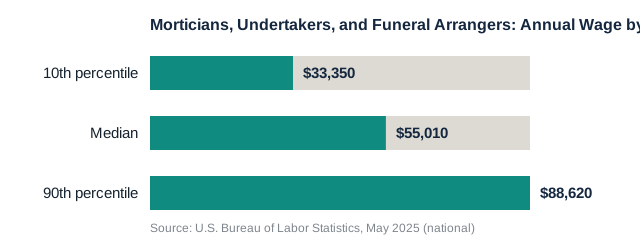
Bar chart showing mortician, undertaker, and funeral arranger (funeral director) annual wage by percentile: 10th percentile $33,350, median $55,010, 90th percentile $88,620, based on BLS May 2025 data.

Key figures

The median annual wage for morticians, undertakers, and funeral arrangers, the title the U.S. Bureau of Labor Statistics uses for what is commonly called a funeral director, was $55,010 in May 2025. The bottom 10% earned less than $33,350 while the top 10% earned more than $88,620. BLS projects 3% employment growth from 2025 to 2035, about as fast as the average for all occupations, adding roughly 800 jobs to a workforce of 26,700.

Morticians, Undertakers, and Funeral Arrangers: Annual Wage by Percentile (May 2025, U.S. national)

10th percentile
$33,350
Median
$55,010
90th percentile
$88,620

Source: BLS Occupational Outlook Handbook: Funeral Service Workers (Morticians, Undertakers, and Funeral Arrangers profile), May 2025.

Tool

See where your salary stands

Enter your own pay as a morticians, undertakers, and funeral arrangers, either annual or hourly, and this tool locates it against the BLS wage percentiles above.

Pay basis

BLS publishes a median hourly wage of $26.45 for this occupation; that real figure is used as the hourly reference. Your own hourly-to-annual conversion assumes 2,080 hours/year (BLS full-time convention).

Calculated client-side from BLS Occupational Outlook Handbook: Funeral Service Workers (Morticians, Undertakers, and Funeral Arrangers profile), May 2025. Not personalized career, financial, or tax advice.

Industry (May 2025) Median annual wage
Death care services $54,530

Jobs (2025)

26,700

Outlook (2025-35)

3%

Employment change

+800

Typical entry education

Associate's degree

What funeral directors earn, and the title BLS actually tracks

BLS does not publish a wage table under the job title "funeral director." Its Occupational Outlook Handbook groups this work under SOC code 39-4031, "Morticians, Undertakers, and Funeral Arrangers," and states directly on that page that these workers are "also known as funeral directors or, historically, undertakers." Anyone searching for funeral director pay is looking at this specific occupation code, not the separate, higher-paid "Funeral Home Managers" title covered below.

The median annual wage for morticians, undertakers, and funeral arrangers was $55,010 in May 2025, or $26.45 an hour. The bottom 10% earned less than $33,350 a year, and the top 10% earned more than $88,620, a spread of roughly $55,270 between the two ends. BLS attributes pay differences within the occupation to years of licensed experience, ownership stake in a funeral home, and regional cost of living, but it does not publish a breakdown that separates those three factors from one another.

BLS separately tracks a related but distinct title, "Funeral Home Managers" (SOC 11-9171), with a higher median of $78,790 in May 2025. That role runs the business side of a funeral home, staffing, budgets, marketing; arranging an individual service is a funeral director's job, not a manager's. BLS notes that funeral home managers typically have multiple years of experience working as a funeral director or mortician first. The two titles are frequently confused online because both appear on the same BLS profile page and both work in the same buildings.

The path in: an associate's degree, a state licensing exam, and a supervised internship

BLS lists an associate's degree as the typical entry-level education, earned through an accredited funeral service or mortuary science program, usually a two-year course of study at a community college that covers ethics, grief counseling, funeral service, business law, embalming, and restorative techniques. Some employers prefer a bachelor's degree, and BLS notes psychology and business as common secondary fields of study for those who pursue one.

Licensing is where this occupation departs from many other associate's-degree roles. Per BLS, most states and Washington, D.C. require funeral directors to hold a state license, and the typical requirements are: being at least 21 years old, completing an accredited funeral service or mortuary science program, passing a state and/or national board exam, and serving an internship lasting one to three years under a licensed funeral director or manager. Colorado is the one exception BLS names, where certification is voluntary, not mandatory. Because licensing is set state by state, working across state lines generally means holding more than one license, and most states also require continuing education credits to keep a license current.

Some states additionally require a separate certification specifically to perform cremations, a requirement BLS notes exists apart from the standard funeral director license and is administered by individual state boards or professional organizations, not by BLS itself.

Where the jobs are concentrated

BLS reports 26,700 morticians, undertakers, and funeral arrangers working in 2025. Death care services was overwhelmingly the largest employer, accounting for 93% of the workforce, with self-employed workers making up another 5% and the remainder in categories BLS does not break out individually. That concentration is unusually tight compared with other allied occupations on this site, where employment is typically split across three or more industries.

Within death care services specifically, BLS reports a median wage of $54,530, essentially matching the occupation-wide median of $55,010. Unlike some occupations this site has covered, where the highest-paying industry and the industry that employs the most workers are two different settings, funeral directors show little industry-based pay variation to report, mainly because BLS does not break out a second industry category with enough workers to publish a separate wage figure.

The related funeral home manager title shows a different employment pattern: 58% self-employed and 40% in death care services, according to BLS, suggesting that ownership or partial ownership of a funeral home is more common at the manager level than at the funeral director level.

Job outlook, and how the pay compares to other associate's-degree occupations

BLS projects 3% employment growth for morticians, undertakers, and funeral arrangers from 2025 to 2035, in line with the 3% average projected across all occupations, taking the occupation from 26,700 to 27,500 workers, a gain of roughly 800 jobs. BLS attributes most of the roughly 5,600 annual openings projected for funeral service workers overall to the need to replace people who leave the occupation or exit the labor force, rather than to net new job creation, and it names one demand-side headwind directly: a continuing shift toward cremation, which BLS says "costs less and requires fewer workers than do traditional funeral arrangements."

Set against other roles that also list an associate's degree as the typical entry point, funeral director pay lands in the middle. Paralegals and legal assistants have a higher median, $61,010, about $6,000 above funeral directors, despite BLS reporting that no U.S. state currently licenses the paralegal occupation at all. Funeral directors, by contrast, clear a state licensing exam and a one-to-three-year supervised internship that most paralegals never have to complete. BLS does not explain why the more heavily regulated role pays less.

The comparison runs the other way against roles with a lower education bar. Dental assistants, whose typical entry point is a postsecondary nondegree award, not a two-year degree, have a median of $47,300, about $7,710 below funeral directors. On this specific pairing, the additional associate's degree, licensing exam, and multiyear internship funeral directors complete does correspond to meaningfully higher typical pay, the opposite pattern from the paralegal comparison above.

Frequently asked questions

What is the average funeral director salary?

BLS files this job under a longer official name (see above), but the pay figure attached to it is simple enough: $55,010 for the year, per its May 2025 release, translating to $26.45 hourly. The lowest-paid tenth of the field fell under $33,350; the highest-paid tenth topped $88,620.

Is a funeral home manager the same job as a funeral director?

No. BLS tracks them as two separate occupations. The manager title (SOC 11-9171) oversees the business end of running the operation and commanded a higher $78,790 that same year, while the director title (SOC 39-4031) handles arranging individual services and paid $55,010. BLS notes that people usually direct first before moving into management.

Do funeral directors need to be licensed?

In most states, yes. Per BLS, a license is required almost everywhere, including Washington, D.C., and getting one generally means clearing four hurdles: turning 21, finishing a two-year mortuary science course of study, passing a board exam, and spending anywhere from twelve months to three years training under a licensed mentor. Colorado stands apart as the single state BLS flags where the credential is optional. Rules differ by state, and covering territory in more than one jurisdiction typically means holding a separate license for each.

What education does a funeral director need?

An associate's degree is the typical bar BLS sets, with coursework covering the emotional side of the job, like grief counseling, alongside embalming technique, restoration work, and the legal side of running a death-care business. Some employers would rather see a full bachelor's.

Is funeral director a growing career?

BLS pegs growth for this occupation at 3% between 2025 and 2035, keeping pace with the broader U.S. labor market, and expanding the field by around 800 workers. Most yearly openings trace back to people exiting the field rather than brand-new jobs being created, and BLS points to more families choosing cremation as one drag on faster hiring.

Can you make six figures as a funeral director?

Not typically, per national BLS numbers. Even the top-earning tenth of this workforce landed at $88,620 in May 2025, the ceiling BLS publishes for the role, which falls short of six figures.

Is it difficult to become a funeral director?

It's a multi-step credentialing process, not something learned purely on the job. A candidate generally completes a two-year mortuary science course of study first, then a board exam, then a stint interning under someone already licensed, lasting a year to three years, before any state signs off. The board exam itself, run nationally by the International Conference of Funeral Service Examining Boards, splits into two separately graded halves, one on the Arts side and one on the Sciences side, both of which have to be cleared. Nothing here comes with an official difficulty rating; what's clear is that it's a years-long sequence of gates, not a single test or a quick certificate.

What is the highest paying job in the funeral industry?

Per BLS, the highest-paying title on the same funeral-service page is Funeral Home Manager (SOC 11-9171), at a $78,790 median in May 2025, about $23,780 above the $55,010 funeral director figure this page covers. That role oversees the administrative and financial end of running the operation, and BLS notes people typically spend several years as a licensed director first, so the higher-paying role is usually a step up rather than a separate entry point.

Cite this

WageLark Editorial, “Funeral Director Salary: BLS Wage Data by Percentile (2026),” WageLark, published August 28, 2026, https://wagelark.com/funeral-director-salary/.

This page reports government wage statistics for informational purposes. It is not personalized career, financial, or legal advice, and does not endorse or recommend any specific employer, school, or training program.

Response card

Did these figures answer your question?

Written and edited by the WageLark Editorial Team