U.S. salary & occupation data · BLS sourced Ser. 2026

Salary Guide SOC 29-2035

MRI Technologist Salary: BLS Wage Data by Percentile (2026)

BLS reports a $95,480 median MRI technologist salary, well above radiologic technologists. See the wage range by percentile and by industry setting.

Last updated 2026-08-29 · Wage data: May 2025 (BLS)

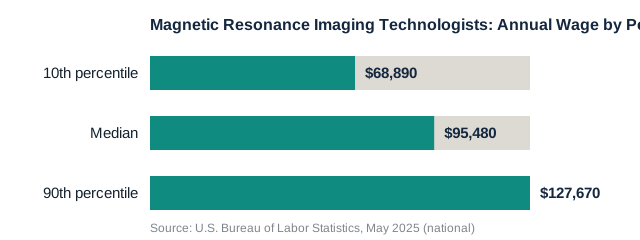
Bar chart showing MRI technologist annual wage by percentile: 10th percentile $68,890, median $95,480, 90th percentile $127,670, based on BLS May 2025 data.

Key figures

The median annual wage for MRI technologists was $95,480 in May 2025, according to the U.S. Bureau of Labor Statistics, about $15,370 above the $80,110 median for radiologic technologists and technicians, the closely related occupation BLS profiles on the same page. The bottom 10% of MRI technologists earned less than $68,890 and the top 10% earned more than $127,670. Pay varies sharply by setting: outpatient care centers paid the highest industry median at $140,390, even though BLS reports only about 3% of MRI technologists actually work in that setting, versus 61% in hospitals.

Tool

See where your salary stands

Enter your own pay as a magnetic resonance imaging technologists, either annual or hourly, and this tool locates it against the BLS wage percentiles above.

Pay basis

BLS publishes a median hourly wage of $45.90 for this occupation; that real figure is used as the hourly reference. Your own hourly-to-annual conversion assumes 2,080 hours/year (BLS full-time convention).

Calculated client-side from BLS Occupational Outlook Handbook: Radiologic and MRI Technologists (SOC 29-2035 covers MRI technologists specifically, a distinct 6-digit code from radiologic technologists' 29-2034 within the combined 29-2030 group; BLS's Pay tab breaks out an MRI-technologist-specific median annual wage ($95,480), 10th/90th percentile wages, and a specific top-4-industry wage table, all used here. The Quick Facts box only shows the combined group's employment/outlook, but the Job Outlook tab's separate Employment Projections Data table breaks 29-2035 out individually: 43,900 jobs in 2025, projected to reach 47,300 by 2035, an 8% growth rate (faster than the 5% for the combined group and for 29-2034 alone) adding 3,400 jobs -- that SOC-specific table, not the combined Quick Facts figure, is what's used here. medianHourly is calculated as medianAnnual / 2080 hours, not a BLS-published figure, following this site's existing convention for occupations where BLS's Quick Facts hourly wage is only given at the combined-group level), May 2025. Not personalized career, financial, or tax advice.

Industry (May 2025) Median annual wage
Outpatient care centers $140,390
Hospitals (state, local, private) $95,920
Offices of physicians $93,880
Medical and diagnostic laboratories $93,540

Jobs (2025)

43,900

Outlook (2025-35)

8%

Employment change

+3,400

Typical entry education

Associate's degree

What MRI technologists actually earn, by percentile

BLS tracks MRI technologist pay through its Occupational Employment and Wage Statistics (OEWS) program under SOC code 29-2035, a distinct six-digit code from radiologic technologists and technicians (29-2034), even though BLS profiles both roles together on one Occupational Outlook Handbook page titled "Radiologic and MRI Technologists." The most recent published wage data, from May 2025, puts the MRI technologist median annual wage at $95,480. BLS does not publish a role-specific hourly figure for MRI technologists on this page; dividing the annual median by a standard 2,080-hour work year works out to roughly $45.90 an hour, a calculated figure rather than one BLS reports directly.

The percentile spread is wide in dollar terms: the bottom 10% of MRI technologists earned less than $68,890 in May 2025, while the top 10% earned more than $127,670, a gap of nearly $58,800. That range sits well above the equivalent spread for radiologic technologists, whose bottom 10% earned less than $55,980 and top 10% earned more than $118,660 on the same page. Both occupations typically require only an associate's degree to enter, so the roughly $15,370 gap between the two medians traces to the additional post-primary certification most MRI technologists complete, not to a difference in base entry credentials. Outside clinical imaging entirely, truck driver pay sits far below either figure, with BLS reporting a $57,440 median annual wage for heavy and tractor-trailer drivers in May 2024.

Pay by industry setting, and a mismatch worth noticing

BLS breaks out May 2025 MRI technologist wages across four industry categories. Outpatient care centers paid the highest median by a wide margin, at $140,390, roughly $44,470 above the next-highest setting. Hospitals paid a median of $95,920, close to the national median for the occupation, followed by offices of physicians at $93,880 and medical and diagnostic laboratories at $93,540.

That $140,390 figure is easy to misread as where most MRI technologists work. BLS's separate work-environment data for this occupation shows the opposite: about 61% of MRI technologists work in hospitals, 17% in medical and diagnostic laboratories, 14% in offices of physicians, and only about 3% in outpatient care centers, the very setting with the highest median pay. Reading the industry wage table without the employment-share data would suggest outpatient centers are a large part of the field; in practice they are a small, higher-paying niche, not the typical work setting.

Job outlook: MRI technologists are projected to grow faster than radiologic technologists

BLS's Quick Facts box for this page only shows one combined figure for "radiologic and MRI technologists" (278,100 jobs in 2025, projected to reach 293,300 by 2035, 5% growth, adding 15,100 positions). But the Job Outlook tab includes a separate Employment Projections Data table that breaks that combined total out by the two specific SOC codes. For MRI technologists (29-2035) alone, BLS projects growth from 43,900 jobs in 2025 to 47,300 by 2035, an 8% increase, adding 3,400 positions. Radiologic technologists and technicians (29-2034), the larger of the two occupations by headcount, are projected to grow from 234,200 to 246,000 jobs, a 5% increase adding 11,800 positions. A much smaller, slower-growing occupation by comparison, this site's funeral director wage data covers morticians, undertakers, and funeral arrangers, with BLS projecting just 3% growth through 2035.

That 8% MRI-specific growth rate is faster than the 5% projected for radiologic technologists on the same page, and faster than the 5% combined-group figure that a reader relying only on the Quick Facts box would see. BLS attributes growth in this occupation pairing to an aging population that needs more diagnostic imaging, along with continued demand for imaging in cancer detection and treatment planning; the agency's SOC-specific table doesn't break out how much of that demand is driving MRI growth specifically versus radiologic imaging generally, but the higher projected growth rate for the MRI role lines up with the wage premium in the section above.

How people become MRI technologists, and how the entry path compares to radiologic technology

Entry-level education for MRI technologists is an associate's degree, the same typical requirement BLS lists for radiologic technologists. BLS does not name a specific credentialing body on this page; the American Registry of Radiologic Technologists (ARRT), which administers the field's MR credential, is a separately confirmed, real credentialing organization, not a BLS-sourced detail. ARRT publishes two distinct routes into that credential. The primary pathway runs through an ARRT-approved MRI educational program that requires at least an associate's degree and documented competence across a set of imaging procedures. The post-primary pathway is the route many working radiologic technologists actually take: it requires already holding an ARRT certification in a supporting discipline, specifically radiography, nuclear medicine technology, radiation therapy, or sonography, plus at least 16 hours of structured MRI-specific education, 125 documented MRI procedure repetitions, and passing the MR certification exam.

That post-primary route is one reason the two occupations on this BLS page are so closely linked in practice: a meaningful share of MRI technologists start out as radiologic technologists, earning the lower of the two medians on this page, and add the MR credential later once they have enough clinical hours to qualify for the post-primary pathway. For a comparison at a similar associate's-degree entry point in a different diagnostic imaging modality, this site's ultrasound technologist salary guide covers sonography, credentialed through a separate body (ARDMS) rather than ARRT, using sound waves instead of magnetic fields. Outside imaging, this site's surgical tech salary guide covers BLS wage data and job outlook for that allied health role.

Frequently asked questions

What does BLS report for the MRI technologist salary?

SOC code 29-2035 is what BLS uses to track this role, and it puts the median at $95,480 a year in May 2025, drawn from its OEWS payroll survey. BLS doesn't publish an hourly figure for this role on the same page; spread across 2,080 work hours in a year, that dollar figure comes out to an unofficial estimate of about $45.90 an hour.

Is an MRI technologist salary higher than a radiologic technologist salary?

Yes. BLS's May 2025 figures put this role's median at $95,480, versus $80,110 for the related radiography role, a gap of about $15,370, even though the two show up side by side in BLS's handbook entry and both accept the same two-year degree as the ticket in.

Which industry pays MRI technologists the most?

BLS breaks pay for this role into four settings for May 2025, and the top-paying one is outpatient care, at $140,390, well above hospitals ($95,920), physicians' offices ($93,880), and diagnostic labs ($93,540). A different BLS table, on where people actually work rather than what they're paid, puts that top-paying setting's share of the workforce at roughly 3%, against 61% employed in hospitals, so the best-paid setting is a small niche rather than where most people in the role actually work.

Is MRI technologist a growing occupation?

Yes, and its projected growth outpaces the related radiography role. BLS's Job Outlook tab reports each SOC code on its own line: MRI technologist headcount is expected to climb from 43,900 in 2025 to 47,300 in 2035, adding 3,400 jobs for an 8% gain, versus a 5% gain for the broader radiography occupation over the same span. Both figures sit above the 3% average growth rate BLS projects across all occupations.

How do you become an MRI technologist?

A two-year college credential, an associate's, is the entry point BLS lists for the role. Separately from BLS, ARRT, the body that credentials imaging technologists nationwide, issues the field's MR certification through two routes: enrolling in an ARRT-approved program that teaches MRI from the ground up, or, for candidates already ARRT-certified elsewhere in imaging, taking the second-entry route instead. That second route additionally requires a passing exam score plus two logged minimums: a 16-hour block of MRI-focused coursework and 125 hands-on MRI procedures.

How long does it take to become an MRI technologist?

There is no single fixed timeline. BLS lists an associate's degree, roughly two years of full-time study, as what both this role and its radiography counterpart typically require to get started. Most people in this field work in radiography first: BLS states MRI technologists typically need less than five years of experience in a related occupation, most often gained as a radiographer, before qualifying for the ARRT's MRI-specific credential the second-entry way.

Is becoming an MRI tech hard?

The credentialing exam is one of the tougher ones ARRT administers. ARRT's 2025 Annual Exam Report puts the overall pass rate for the Magnetic Resonance Imaging exam at 75%, versus 86% for the base Radiography exam, meaning roughly one in four candidates doesn't clear it on a given attempt. That's on top of qualifying to sit for it in the first place, which for most candidates means qualifying as a radiographer first and racking up the clinical hours ARRT requires under its second-route rules before the MRI-specific exam even comes into play.

Is MRI tech a stressful job?

BLS doesn't rate occupations for stress, but its description of the physical side of the job points to real day-to-day demands: people in this role and its imaging counterpart are often on their feet for long periods and may need to lift or turn patients, including those who are injured or unable to move themselves. Add to that the mental load of running expensive imaging equipment correctly, positioning patients precisely, and managing anxious or claustrophobic patients inside an MRI bore, and the job carries real physical and cognitive demands even though BLS itself doesn't use the word "stressful."

Cite this

WageLark Editorial, “MRI Technologist Salary: BLS Wage Data by Percentile (2026),” WageLark, published August 29, 2026, https://wagelark.com/mri-tech-salary/.

This page reports government wage statistics for informational purposes. It is not personalized career, financial, or legal advice, and does not endorse or recommend any specific employer, school, or training program.

Response card

Did these figures answer your question?

Written and edited by the WageLark Editorial Team