The 7-year timeline BLS actually gives
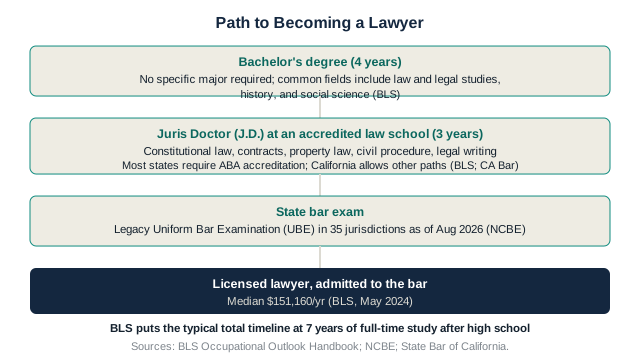
Per BLS, becoming a lawyer usually takes 7 years of full-time study after high school: 4 years of undergraduate study followed by 3 years of law school. Most law schools do not require a specific bachelor's major for admission, though BLS notes that applicants commonly come in having studied law and legal studies, history, or social science. A similar gap between assumed and actual program length shows up in nursing: this site's guide to nursing school length explains why BLS lists both the BSN and the associate's-degree path at about 4 years, not the 2 years often assumed.
That 7-year figure covers the degree itself, not the ability to practice. Most states require the J.D. to come from a law school accredited by the American Bar Association (ABA); a J.D. from an ABA-accredited school has been treated as sufficient by every U.S. jurisdiction. California is the most notable exception: per the State Bar of California, applicants can also qualify for the California bar exam through four years of study at a state-registered but not ABA-accredited fixed-facility law school (a minimum of 270 classroom hours a year), or through a registered correspondence or distance-learning law school (a minimum of 864 study hours a year). Students at those unaccredited schools must additionally pass the First-Year Law Students' Examination, informally called the "baby bar," after their first year. Per the State Bar of California, passing it within three consecutive administrations credits all law study completed up to that point; passing on a later attempt credits only one year of study toward the degree requirement.
Before law school: an admissions test that is starting to loosen
Most law schools still require the LSAT, administered by the Law School Admission Council (LSAC) and scored on a 120-to-180 scale, or, at a growing number of schools, the GRE, as part of the admissions file alongside transcripts and letters of recommendation. That has been the near-universal norm for decades under ABA accreditation rules.
It is starting to change at the margins. In late 2024, the ABA Council of the Section of Legal Education and Admissions to the Bar agreed to let individual law schools apply for a variance from the standardized-test requirement, permitting up to 100% of an entering class to be admitted without an LSAT or GRE score, for a period of up to five years. Schools that use the variance must report outcome data back to the ABA, including first-year grades, attrition, and eventual bar passage rates. Fourteen law schools had been granted this variance as of 2025. That remains a small minority of the roughly 200 ABA-accredited law schools nationwide; the LSAT or GRE is still the norm for most applicants.
The J.D. does not let anyone practice on its own
BLS states plainly that all states require lawyers to be licensed, and that requirements vary by state. Candidates must graduate from an accredited law school and then pass a bar exam before they can practice, a step separate from and after finishing the degree itself. Bar exams are coordinated at the national level by the National Conference of Bar Examiners (NCBE), which develops the (legacy) Uniform Bar Examination (UBE): the Multistate Essay Examination, two Multistate Performance Test tasks, and the Multistate Bar Examination, combined into a single scaled score.
Not every state uses the same exam. Per NCBE's own current jurisdiction list, checked directly on 2026-08-17, 35 of the 51 U.S. jurisdictions it tracks (34 states plus the District of Columbia) have adopted the legacy UBE; the rest, including California, Florida, and several others, administer their own state-specific bar exam instead. A UBE score is portable: it can be transferred to seek admission in any other UBE jurisdiction without retaking the exam, though some UBE jurisdictions still require passing a separate, shorter local-law component first. NCBE is also phasing in a redesigned NextGen UBE, with the legacy exam scheduled to stop being administered after February 2028, so the specific exam format a given state uses is likely to keep shifting over the next few years.
Passing the bar and being "admitted to the bar" is not the final step either. Per BLS, states may require lawyers to participate in continuing legal education (CLE) to maintain their license, on top of the one-time licensing exam.
What the extra years buy, against other long-training paths on this site
BLS reports a median annual wage of $151,160 for lawyers in May 2024, or $72.67 an hour. The bottom 10% earned less than $72,780, and the top 10% earned more than $239,200, the ceiling BLS publishes for this figure rather than an exact top value; that data excludes self-employed lawyers and law-firm owners or partners. By industry, BLS lists federal government roles at the highest median it tracks, $174,680, ahead of legal services (the largest employer segment) at $143,470, local government excluding education and hospitals at $125,180, and state government excluding education and hospitals at $111,280, the lowest of the four. BLS projects 4% employment growth for lawyers from 2024 to 2034, which it classifies as about as fast as average, adding roughly 31,500 openings a year, most from the need to replace workers who transfer to other occupations or leave the labor force rather than from newly created positions.
Against other occupations on this site that require a doctoral or professional degree, the lawyer figure sits at the top of the group: pharmacists, who need a Doctor of Pharmacy (PharmD), post a lower BLS median of $140,910, and physical therapists, who need a three-year Doctor of Physical Therapy after a bachelor's degree plus a licensing exam, post $101,020. Paralegals, whose BLS page lists lawyers as a comparison point precisely because paralegals support them without being licensed to practice law, post a considerably lower median of $61,010 on an associate's-degree or certificate entry path. None of these comparisons account for a reader's own state, practice area, or years of experience, and BLS's national medians are not built to say which path is the better financial bet for any one person. For a field on a different degree track, this site's guide to becoming a software engineer covers the degree, path, and pay.