What BLS says it actually takes to start
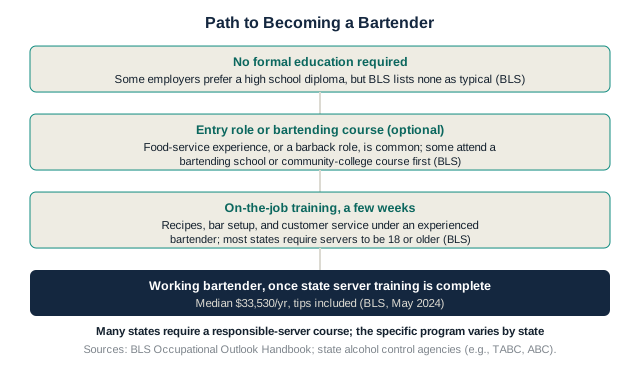
Per BLS, bartenders typically need no formal education credential to enter the occupation, though some employers prefer or require a high school diploma. There is no related-work-experience requirement either, but BLS notes that many employers prefer candidates who already have food-service experience, in roles such as waiter, waitress, or bartender helper. Some aspiring bartenders instead attend a bartending school or take a course at a community college first; these programs typically cover mixing cocktails, serving customers, and setting up a bar, and BLS notes some schools help graduates find jobs, though BLS treats attending one as optional, not something it actually requires.
On-the-job training is the part BLS describes as the norm: a few weeks under an experienced bartender learning cocktail recipes, bar-setup procedures, and customer service, including how to handle unruly customers. Where bartenders also serve food, BLS says training can extend to teamwork and food-handling procedures. Some employers instead use self-study materials, such as videos and instructional booklets, to teach the same skills. Most states require anyone serving alcoholic beverages to be at least 18 years old, and BLS notes bartenders must know the state and local laws governing alcohol sales in whichever jurisdiction they work.
The step that varies by state: responsible-server training
BLS states that many states and localities require bartenders to complete a responsible-server course, typically covering the laws around selling alcohol, responsible serving practices, and conflict management, and that professional certification, while optional, may demonstrate basic competency to an employer; BLS points readers to CareerOneStop, a U.S. Department of Labor resource, for information on available certifications. What BLS does not spell out is how much this varies by state, so this section checks that pattern against a second, independent source rather than assuming BLS's general description applies uniformly everywhere.
Some states run their own named program: Texas ties its TABC seller/server certification to a "Safe Harbor" liability defense for the employer under state alcohol law, so a business that wants that protection must certify every alcohol-handling employee within 30 days of hire, which in practice means nearly every Texas bartender ends up TABC-certified even though the certification itself is not a direct criminal mandate on the individual server; California requires Responsible Beverage Service (RBS) training and a passing exam directly of the server, typically within 60 days of the first day of work, with the credential valid for three years; Washington requires a Mandatory Alcohol Server Training (MAST) permit, typically within 60 days of hire; and Illinois requires certification under its Beverage Alcohol Sellers and Servers Education and Training (BASSET) program, typically within 120 days of hire. Other states have no statewide mandate at all, though a city or county within that state may still require training on its own. Because the rule, the program name, and the compliance window differ by state, and in some cases by city, a bartender needs to confirm the specific requirement with their own state's alcohol control agency rather than assume a single national standard, the same caveat BLS gives for state licensing throughout its occupational profiles.
Pay: what the numbers cover, and what they leave out
BLS reports a median hourly wage of $16.12 for bartenders in May 2024, equivalent to $33,530 a year, below the $23.80 median hourly wage across all occupations in the economy. These figures include tips: tipped employees earn at least the federal minimum wage, paid as some combination of direct wages and tips depending on the state, and the U.S. Department of Labor's Wage and Hour Division maintains a state-by-state list of minimum wages for tipped employees. The 10th percentile earned less than $9.58 an hour, and the 90th percentile earned more than $34.58, a spread of more than 3.5 times between the bottom and top of the range.
BLS does not publish an annual figure for those percentile boundaries or for its industry breakdown on this occupation, only hourly ones, which this page reports as BLS gives them rather than converting to an assumed full-time annual number. That gap reflects a real feature of the job: BLS separately notes that bartenders often work late evenings, weekends, and holidays, and that part-time work is common with schedules that vary, so a straight hourly-times-2080 conversion would imply a full-time year that many bartenders do not actually work. By industry, BLS reports the highest hourly median in traveler accommodation ($17.18), followed by full-service restaurants ($16.87), drinking places that serve alcoholic beverages ($15.00), amusement, gambling, and recreation industries ($14.77), and civic and social organizations ($13.18).
Outlook, and how the training bar compares to other no-degree paths on this site
BLS projects 6% employment growth for bartenders from 2024 to 2034, faster than the roughly 3% average across all occupations, adding an estimated 44,800 jobs to the 756,700 already employed in 2024. About 129,600 openings are projected each year on average, and BLS attributes most of that to population and income growth increasing demand for food, drinks, and entertainment, particularly at full-service restaurants and breweries, plus continued need to replace workers who transfer to other occupations or leave the labor force. For a related food-service occupation, this site's chef and head cook salary guide covers BLS wage data by percentile.
Bartending sits at the short end of the training-length spectrum among no-degree occupations covered on this site. BLS lists no formal education requirement and a few weeks of on-the-job training for bartenders, compared with becoming a CNA, which requires a federal minimum of 75 hours of state-approved training, and the structured, multi-year apprenticeship model behind a plumbing apprenticeship, which typically runs 4 to 5 years. Welding lands in between: BLS describes several viable entry routes rather than one standard path, from a few months of employer on-the-job training to a longer vocational program. That shorter training time comes with a lower median: BLS puts the bartender median at $33,530 a year, below the $42,260 BLS reports for nursing assistants and further below the $53,750 median for welders, cutters, solderers, and brazers. BLS data describes national training requirements and pay levels for each occupation; it is not a claim that any one path is the better choice for a given reader.