U.S. salary & occupation data · BLS sourced Ser. 2026

Career Guide SOC 29-1171

What Does a Nurse Practitioner Do? Duties, Setting, and Pay

Nurse practitioners assess, diagnose, and treat patients, and in most states can prescribe independently. Here is what the BLS says the job actually covers.

Last updated 2026-08-26 · Wage data: May 2024 (BLS)

Diagram showing four core nurse practitioner duties: assessing patients (history, exam, tests), diagnosing health problems, treating with medication and care plans, and counseling patients while consulting with physicians.

Key figures

Per the U.S. Bureau of Labor Statistics, nurse practitioners (SOC 29-1171) are advanced practice registered nurses who take patient histories, perform physical exams, order and interpret diagnostic tests, diagnose health problems, and prescribe medication, typically focused on a specific patient population such as adult-gerontology, pediatric, or psychiatric-mental health care. BLS groups nurse practitioners with nurse anesthetists and nurse midwives on a single occupational profile page and reports a nurse-practitioner-specific median annual wage of $129,210 in May 2024, with 40% employment growth projected through 2034.

Nurse Practitioners: Annual Wage by Percentile (May 2024, U.S. national)

Median
$129,210

Source: BLS Occupational Outlook Handbook: Nurse Anesthetists, Nurse Midwives, and Nurse Practitioners, May 2024.

Tool

See where your salary stands

Enter your own pay as a nurse practitioners, either annual or hourly, and this tool locates it against the BLS wage percentiles above (this occupation only has a published median, not a fuller percentile breakdown, as noted below).

Pay basis

BLS does not publish a separate hourly median for this occupation, so hourly figures here are the annual figure divided by 2,080 hours/year (BLS full-time convention).

Calculated client-side from BLS Occupational Outlook Handbook: Nurse Anesthetists, Nurse Midwives, and Nurse Practitioners, May 2024. Not personalized career, financial, or tax advice.

Jobs (2024)

320,400

Outlook (2024-34)

40%

Employment change

+128,400

Typical entry education

Master's degree

The core of the job

BLS tracks nurse practitioners on a combined occupational profile page shared with nurse anesthetists and nurse midwives, grouping all three together as advanced practice registered nurses (APRNs). Per BLS, APRNs typically take and record patients' medical histories and symptoms, perform physical exams, create or contribute to patient care plans, order and perform diagnostic tests, operate and monitor medical equipment, diagnose health problems, analyze test results and adjust treatment plans as needed, give patients medicines and treatments, evaluate how a patient responds to that treatment, consult with physicians and other healthcare professionals as needed, counsel and teach patients and their families, and, for some, conduct research.

Within that shared duty list, BLS describes nurse practitioners specifically as serving "as primary and specialty care providers, delivering advanced nursing services to patients and their families." NPs assess patients, decide how to improve or manage a patient's health, and work with patients on integrating health-promotion strategies into daily life. Per BLS, nurse practitioners typically focus on a specific patient population, such as adult and geriatric health, pediatric health, or psychiatric and mental health, a specialization that shapes which patients and conditions an individual NP actually sees day to day.

BLS also draws a specific line between this role and registered nursing: nurse practitioners share some duties with RNs, including gathering information about a patient's condition and taking action to manage it, but are trained for tasks RNs are not, including ordering and evaluating test results, referring patients to specialists, and diagnosing and treating health problems.

How much of this an individual nurse practitioner can do without a supervising or collaborating physician depends entirely on the state where they practice. BLS notes broadly that scope of practice for this occupational group varies from state to state; this site's nurse practitioner salary guide covers the state-by-state practice-authority rules in more depth and where to check a specific state's current status.
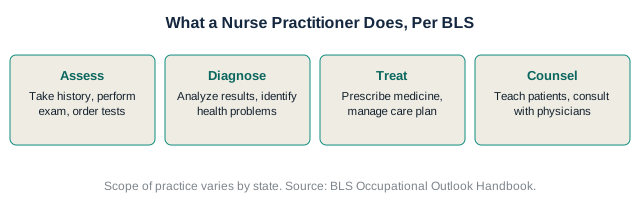
Diagram showing four core nurse practitioner duties: assessing patients (history, exam, tests), diagnosing health problems, treating with medication and care plans, and counseling patients while consulting with physicians.

Where nurse practitioners work, and what the schedule looks like

BLS reports employer data for the combined group of nurse anesthetists, nurse midwives, and nurse practitioners rather than for nurse practitioners alone: offices of physicians employed the largest share at 46%, followed by hospitals at 25%, outpatient care centers at 9%, offices of other health practitioners at 5%, and educational services at 3%. Nurse practitioners made up the largest slice of the underlying 382,700 combined jobs in 2024, at 320,400, so the employer mix likely tracks fairly closely with where NPs specifically work, even though BLS does not publish an NP-only version of this table.

Per BLS, some APRNs provide care in patients' homes, and some may travel long distances to reach patients in areas with a shortage of healthcare workers. This site's nurse practitioner salary guide discusses how that pattern connects to rural and underserved-area demand for NPs in more depth.

Most APRNs work full time, per BLS. Those in physicians' offices typically work standard business hours, while those in hospitals and other healthcare facilities may work shifts, including nights, weekends, and holidays, to cover round-the-clock patient care; some, especially those in critical care settings, are also expected to be on call.

The physical and emotional demands, in BLS's own description

BLS describes this work as both physically and emotionally demanding. Some APRNs spend much of the day on their feet, and lifting and moving patients puts them at risk of back injury. BLS names the emotional weight of the role directly, too: APRNs make critical decisions that affect a patient's health, and that responsibility is itself a source of job stress. Because of the settings they work in, APRNs may also come into close contact with infectious disease and must follow strict guidelines against risks such as accidental needle sticks or a patient outburst.

Physician assistants do similar clinical work (assessing, diagnosing, treating) but under a supervising physician in nearly every state, rather than independently in a majority of them the way many nurse practitioners can. This site's guide to what a physician assistant does covers that role's own duties and setting.

Frequently asked questions

What does a nurse practitioner do on a typical day?

Per BLS, day-to-day duties include reviewing a patient's health background, conducting exams, ordering and reading diagnostic results, working out a diagnosis, and prescribing treatment, usually within one population focus, like caring for adults and the elderly, treating children, or handling mental and behavioral health. NPs also spend time explaining care plans to patients and coordinating with the rest of a patient's care team.

What's the difference between a nurse practitioner and a registered nurse?

BLS draws the line by noting NPs and RNs overlap on basic duties, like assessing a patient's status and responding to it, but NPs go further: they're trained to order and evaluate test results, route people to the right specialist, and put together a diagnosis and treatment plan, tasks outside a registered nurse's scope.

Can nurse practitioners practice without a supervising physician?

There's no fixed national answer; it comes down to which state someone practices in. See this site's NP salary and scope-of-practice guide for how the state categories break down, and confirm current rules for any one state directly through that resource.

Do nurse practitioners specialize?

Yes. Per BLS, most NPs concentrate on one population group, such as adults and older patients, children, or people needing mental and behavioral healthcare, which shapes the day-to-day mix of conditions and patients any one practitioner sees.

How much do nurse practitioners make?

BLS's May 2024 figure puts this role's pay at $129,210 a year. See NP pay data for the full wage and job-outlook breakdown.

How many years of school does it take to become a nurse practitioner?

BLS doesn't spell out one single combined total on this page either; it describes the requirement as at least a master's degree in an advanced practice nursing specialty, built on top of an existing RN license, with most programs preferring candidates who already hold a bachelor's degree in nursing. Based on typical program lengths, a four-year undergraduate degree followed by a master's- or doctoral-level NP program, sources outside BLS commonly put the full path at roughly six to eight years, though the exact timeline depends on the school and whether a candidate already has RN experience.

What is the highest paid nurse practitioner?

BLS doesn't say. It keeps this a single national figure, $129,210 for May 2024, and skips a wage breakdown by population focus such as family care, mental and behavioral health, or acute care. Several nursing-industry and job-board sites report the mental-health and acute-care tracks among the higher-paid ones, but those figures come from self-reported salary surveys rather than BLS's employer-reported data, and different sites report different dollar amounts for the same specialty. See this site's NP wage breakdown for the full picture.

Is an RN higher than a nurse practitioner?

No, it works the other way. This advanced-practice role is built on top of the RN credential: someone must already be a licensed registered nurse before completing the additional graduate education BLS lists as the typical entry-level requirement. That added training brings a broader scope of practice, such as diagnosing conditions and prescribing medication, that a base RN license does not include on its own.

Cite this

WageLark Editorial, “What Does a Nurse Practitioner Do? Duties, Setting, and Pay,” WageLark, published August 26, 2026, https://wagelark.com/what-does-a-nurse-practitioner-do/.

This page reports government wage statistics for informational purposes. It is not personalized career, financial, or legal advice, and does not endorse or recommend any specific employer, school, or training program.

Response card

Did these figures answer your question?

Written and edited by the WageLark Editorial Team