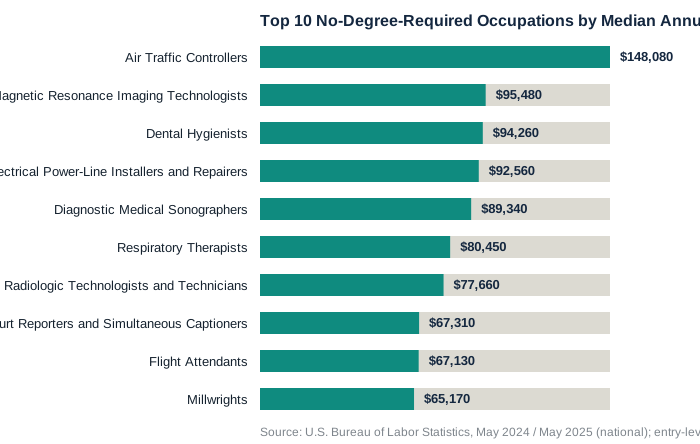
The 10 highest-paying occupations that don't require a four-year degree
Every wage figure below comes straight from the BLS Occupational Employment and Wage Statistics (OEWS) data already cited on this site's individual salary pages, filtered down to the 29 occupations (of the 48 covered here) where BLS lists the typical entry-level education as something short of a bachelor's degree: high school diploma, some college with no degree, a postsecondary nondegree award, an associate's degree, or a state-approved training program. Ranked by median annual wage, the top 10 span aviation, healthcare technician roles, and the skilled trades:
| Rank | Occupation | BLS entry education | Median annual wage |
|---|---|---|---|
| 1 | Air Traffic Controllers | Associate's degree | $148,080 |
| 2 | Magnetic Resonance Imaging Technologists | Associate's degree | $95,480 |
| 3 | Electrical Power-Line Installers and Repairers | High school diploma or equivalent | $95,320 |
| 4 | Dental Hygienists | Associate's degree | $94,260 |
| 5 | Diagnostic Medical Sonographers | Associate's degree | $89,340 |
| 6 | Respiratory Therapists | Associate's degree | $80,450 |
| 7 | Radiologic Technologists and Technicians | Associate's degree | $77,660 |
| 8 | Court Reporters and Simultaneous Captioners | Postsecondary nondegree award | $67,310 |
| 9 | Millwrights | High school diploma or equivalent | $65,700 |
| 10 | Plumbers, Pipefitters, and Steamfitters | High school diploma or equivalent | $63,800 |
| 11 | Flight Attendants | High school diploma or equivalent | $63,580 |
| 12 | Electricians | High school diploma or equivalent | $63,190 |
| 13 | Surgical Technologists | Postsecondary nondegree award | $62,830 |
| 14 | Paralegals and Legal Assistants | Associate's degree | $61,010 |
| 15 | Chefs and Head Cooks | High school diploma or equivalent | $60,990 |
| 16 | Heating, Air Conditioning, and Refrigeration Mechanics and Installers | Postsecondary nondegree award | $59,810 |
| 17 | Firefighters | Postsecondary nondegree award | $59,280 |
| 18 | Paramedics | Postsecondary nondegree award | $58,410 |
| 19 | Heavy and Tractor-trailer Truck Drivers | Postsecondary nondegree award | $57,440 |
| 20 | Morticians, Undertakers, and Funeral Arrangers | Associate's degree | $55,010 |
| 21 | Welders, Cutters, Solderers, and Brazers | High school diploma or equivalent | $53,750 |
| 22 | Bookkeeping, Accounting, and Auditing Clerks | Some college, no degree | $49,210 |
| 23 | Dental Assistants | Postsecondary nondegree award | $47,300 |
| 24 | Veterinary Technologists and Technicians | Associate's degree | $45,980 |
| 25 | Medical Assistants | Postsecondary nondegree award | $45,690 |
| 26 | Phlebotomists | Postsecondary nondegree award | $43,660 |
| 27 | Pharmacy Technicians | High school diploma or equivalent | $43,460 |
| 28 | Nursing Assistants | State-approved training program | $42,260 |
| 29 | Bartenders | No formal educational credential | $33,530 |
All 29 are listed with sources in the downloadable dataset linked at the bottom of this page. The full spread runs from air traffic controllers at $148,080 down to bartenders at $33,530, a nearly $115,000 gap within a group whose only shared trait, per BLS's classification, is skipping the four-year-degree requirement to enter.
What BLS's education label leaves out
"No bachelor's degree required" is not the same as "no training required," and the top of this list makes that clearest. BLS lists an associate's degree as the typical entry path for air traffic controllers, but getting hired actually requires completing an FAA-approved collegiate program or several years of qualifying work experience, passing a medical and background screen, and then finishing training at the FAA Academy before ever working a live position, per this site's air traffic controller salary page. The role also carries an entry age cutoff (generally 31, extended to 35 for some applicants) and a mandatory retirement age of 56, neither of which shows up in a one-line education field.
The same gap shows up further down the list. Firefighters and paramedics are both coded as "postsecondary nondegree award," a category that in practice covers a fire academy plus, for many departments, EMT or paramedic certification stacked on top. Electricians and plumbers, pipefitters, and steamfitters both fall under "high school diploma or equivalent," the same label BLS uses for occupations with a few weeks of on-the-job training, even though a standard electrical or plumbing apprenticeship runs four to five years at roughly 2,000 paid hours a year. The education field on this list, and on the BLS pages it comes from, describes the minimum credential to be considered for the role. It does not describe how long it actually takes to become fully qualified, and that gap is bigger for some occupations on this list than others.
A pattern in where the pay actually is
Two clusters account for most of this list. Healthcare technician roles that require an accredited program and, in most states, a license or certification exam make up five of the top seven: MRI technologists, dental hygienists, diagnostic medical sonographers, respiratory therapists, and radiologic technologists all pay a median above $77,000. The other cluster is licensure- or apprenticeship-gated trades and public-safety roles: electrical linework and plumbing, alongside court reporting, a field where BLS lists a postsecondary nondegree award rather than a bachelor's degree, but where working in a legal setting typically also requires a state license or professional certification on top of that program.
What both clusters share is a credentialing bottleneck of some kind, a licensing board, an accredited program with limited seats, or a certification exam, that keeps supply from expanding as fast as it might for an occupation with the same pay and open entry. Bookkeeping, accounting, and auditing clerks, the one occupation on the full 29-item list BLS projects will shrink over the next decade (down 6%, mostly from software automating routine reconciliation work), sits near the bottom of this ranking at $49,210 and has no equivalent licensing bottleneck protecting it. That contrast is suggestive, not proof; BLS publishes wage and outlook data without explaining why any single occupation pays what it pays, and this page reports the pattern rather than asserting the bottleneck causes the pay level.
What this ranking is, and what it is not
This is a ranking of the 48 occupations WageLark currently has BLS wage data for, not a ranking of every occupation in the U.S. economy that skips a bachelor's degree. BLS's own SOC system covers roughly 800 detailed occupations, and plenty of well-paying no-degree fields, industrial machinery repair outside the roles covered here, certain unionized construction trades, some sales roles, aren't yet built out on this site with the same percentile-and-industry breakdown the rest of this list gets. Treat this as a ranking within a growing, currently 48-occupation dataset, not a claim about the full labor market.
Download the full dataset (CSV, all 29 occupations, one row each)