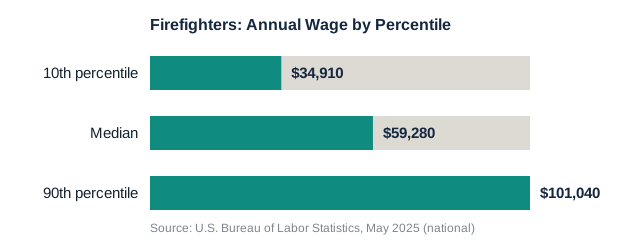
What firefighters earn, and how that compares to the broader labor market
The Bureau of Labor Statistics tracks this role under SOC code 33-2011. For May 2025, BLS reported a median annual wage of $59,280, or $28.50 an hour, for the roughly 355,300 people employed as firefighters nationwide. On the same page, BLS lists the median across all occupations in the economy as $50,980, putting firefighters above that broader national wage benchmark. The bottom 10% of firefighters earned less than $34,910 a year, while the top 10% earned more than $101,040, a spread of roughly $66,000 that BLS attributes to differences in department size, rank, region, and years of service rather than any single factor.
These figures cover paid, career firefighters only. BLS is explicit that its employment and wage numbers "exclude volunteer firefighters, who share the same duties as paid firefighters," and notes separately that volunteers "account for the largest share of firefighters nationwide, especially in communities of fewer than 25,000." That means the $59,280 median describes the career workforce BLS surveys for pay, not the full population of people who do firefighting work in the United States.
BLS also groups firefighters under a broader "firefighting and prevention workers" category, which also includes fire inspectors and investigators and had a slightly higher median hourly wage of $28.67 (about $59,630 a year using the standard 2,080-hour work year BLS applies) for May 2025. The firefighter-specific figure used throughout this page, $59,280, is the narrower number for the occupation itself.
Pay by government level, and where career firefighters actually work
BLS breaks out May 2025 median wages for firefighters by the three employer categories it tracks: state government, excluding education and hospitals, at $64,980; federal government, excluding postal service, at $63,270; and local government, excluding education and hospitals, at $59,850. The spread between the highest- and lowest-paying tier is about $5,100, a much narrower gap than some other public-facing occupations this site has covered, where the difference between the best- and worst-paying industry can run into the tens of thousands of dollars.
Despite paying the least of the three tiers, local government is where the large majority of career firefighters actually work: BLS puts local government at 87% of firefighter employment, versus 4% for state government and 2% for federal government (excluding postal service). BLS does not publish a combined percentage that accounts for the remaining employers, and it does not explain why state and federal positions pay modestly more than local ones on this page; it presents the industry breakdown descriptively rather than attributing the gap to a specific cause such as unionization, cost-of-living adjustments, or department budgets.
Firefighters typically work long, irregular shifts. BLS describes shift patterns such as 24 hours on duty followed by 48 or 72 hours off, and notes that wildland firefighters combating forest fires may work extended stretches and stay at temporary fire camps for days or weeks when a fire breaks out. Wildland firefighting work can also be seasonal, meaning hours and pay may vary by time of year for firefighters in that specialty in ways the annual median wage figure does not capture.
How people become firefighters, and how that compares to other entry paths on this site
BLS states that firefighters typically need a high school diploma and training in emergency medical services to enter the occupation, with no college degree required to start. Most receive their initial training at a fire academy run by a local fire department or the state, covering firefighting and fire-prevention techniques, local building codes, and emergency medical procedures, followed by a probationary period on the job. Despite that high-school-diploma hiring bar, BLS classifies the occupation's "typical entry-level education" as a postsecondary nondegree award; the firefighters page itself does not spell out why, but BLS elsewhere uses that same category label for occupations built around a standalone certification earned after high school, such as EMTs, which lines up with the postsecondary EMT certification training most departments require alongside the fire academy itself.
Beyond initial hiring, BLS notes that licensing and certification requirements, such as EMT or paramedic status, vary by state or locality, and that some jurisdictions also require a commercial driver's license or a driver's license with a firefighter endorsement to operate a firetruck. Continuing education is required to maintain these credentials. Wildland firefighters specifically may go through apprenticeship programs lasting up to four years that combine instruction with supervised on-the-job training. For advancement, BLS describes a promotion track from firefighter to engineer, then lieutenant, captain, battalion chief, assistant chief, deputy chief, and chief, and notes that many departments require a bachelor's degree, often in fire science or public administration, for promotion beyond battalion chief.
Firefighters out-earn some, but not all, of the other entry paths this site has covered that skip a bachelor's degree. Electricians sit a bit higher at the median, at $63,190 versus $59,280 for firefighters, and BLS lists the same nominal hiring bar of a high school diploma for both, though electricians train through a 4- to 5-year, mostly on-the-job apprenticeship rather than a fire academy plus EMT certification. CNAs, by contrast, need a much shorter training bar, a state-approved program with a federal floor of 75 hours under 42 CFR § 483.152, and BLS puts the nursing assistant median at $42,260, well below both firefighters and electricians. Ironworkers, also a high school diploma-entry trade on this site, land on either side of the firefighter figure depending on which of the two BLS ironworking occupations is in question: structural iron and steel workers post a $62,780 median, about $3,500 above firefighters, while reinforcing iron and rebar workers come in at $58,970, just under. BLS does not quantify how much of these gaps owes to training length, licensing requirements, physical risk, or other factors it does not isolate on any of these pages.
Job outlook, and why growth trails some other trades on this site
BLS projects 4% employment growth for firefighters from 2025 to 2035, which it classifies as "about as fast as average," slightly ahead of the roughly 3% growth rate it projects across all occupations combined. That is a slower projected rate than some other occupations this site has covered; electricians, for comparison, carry a 9% "much faster than average" projection over the same period. BLS attributes the more modest firefighter outlook partly to a long-term decline in structure fires and fire fatalities tied to improved building materials and building codes, while noting that wildland firefighters will still be needed to combat active fires and manage fire risk, and that firefighters generally will continue responding to medical emergencies, which BLS says make up most calls firefighters answer, not just fires.
BLS estimates about 26,800 openings for firefighters each year on average over the decade, adding up to a projected employment change of 13,100 jobs by 2035. As with most occupations BLS tracks, it attributes many of those annual openings to the need to replace workers who transfer to other occupations or leave the labor force, such as to retire, rather than to newly created positions alone.
This projection describes national demand for the occupation as a whole; it is not a forecast for any specific fire department, city, or individual's hiring odds or job security. A slower national growth rate also does not by itself indicate anything about pay trends, since BLS publishes wage and employment-growth figures as separate, independently derived statistics on this page.