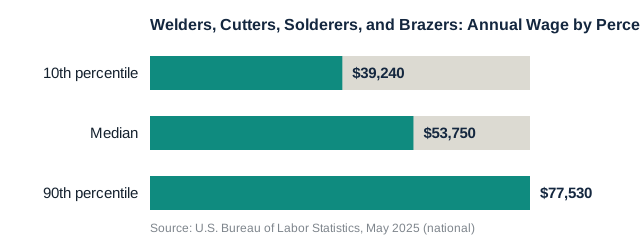
What welders earn, and how wide the pay spread runs
SOC code 51-4121 is BLS's catch-all for welders, cutters, solderers, and brazers, defined as workers who use hand-held or remotely controlled equipment to join, repair, or cut metal parts and products. Roughly 437,700 people held these jobs in 2025, and BLS put the median annual wage at $53,750 that May, or $25.84 an hour. Pay ran from less than $39,240 at the 10th percentile to more than $77,530 at the 90th, a gap of roughly $38,290. That single wage figure covers all four job titles under the SOC code; BLS does not break out percentiles separately by specialty. For duties and safety on the job, see this site's guide to what a welder does.
That $53,750 figure folds together four separate job titles BLS tracks under one SOC code and tells apart by technique, not pay: welders, cutters, solderers, and brazers. BLS doesn't publish wage data for any of the four individually.
BLS also places the occupation against two broader comparison points on the same page: a $49,800 median across "metal workers and plastic workers" as a group, and a $50,980 median across all occupations in the economy. Welders and related workers sit above both. BLS publishes the three figures side by side without breaking down what accounts for the difference, whether that's skill level, certification, or the physical demands of the work. A job with a similar median but a far wider spread is real estate sales, where BLS puts the sales agent median at $52,830 and the 90th percentile at $123,590 (see how much real estate agents make a month).
On growth, BLS projects 2% employment growth for welders, cutters, solderers, and brazers from 2025 to 2035, which it classifies as slower than average against the roughly 3% figure for all occupations combined. That said, the occupation still outpaces the broader metal workers and plastic workers group, which BLS projects will shrink 3% over the same period on the same comparison chart.
Industry pay, and where the jobs actually are
BLS breaks out May 2025 wages by industry into three categories for this occupation. Specialty trade contractors paid the highest median at $59,440, followed by repair and maintenance at $56,080, then manufacturing at $51,210, the lowest of the three even though manufacturing is by far the largest employer.
On who actually employs welders, BLS lists manufacturing at 61% of all jobs, specialty trade contractors at 8%, self-employed workers at 6%, and repair and maintenance at 4%, with the remainder spread across smaller industries the Handbook page does not break out individually. That means most welders work in the lowest-paying of the three tracked industries by median wage. BLS does not explain the gap on this page, so a reader can't tell from the Handbook alone whether it reflects company size, union coverage, or some other factor not captured in a single median figure.
BLS also flags the job's physical side: outdoor and confined-space work, plus rotating shifts. See this site's guide to what a welder does for those conditions in full. Wages vary with the worker's experience, skill level, industry, and the size of the company, per BLS, though the Handbook page does not quantify how much any single factor moves pay.
How to become a welder, and how the entry path compares to other trades on this site
Per BLS, welders typically need a high school diploma or equivalent combined with technical and on-the-job training to enter the occupation, with no postsecondary degree required. That training is available through high school technical education classes, vocational-technical institutes, community colleges, private welding schools, or the U.S. Armed Forces. BLS also lists coursework in blueprint reading, shop mathematics, and mechanical drawing as useful preparation, along with a general understanding of electricity.
Workers can also enter through an employer-based apprenticeship. BLS notes some apprenticeships accept entry-level workers with no prior experience, while others are aimed at people who have already completed a vocational-technical welding program. Employers who hire inexperienced workers directly still typically provide several months of additional on-the-job training, even for those who arrive with formal technical education, according to BLS.
On credentials, BLS states that welders must be licensed in some states and localities, though requirements vary, and it directs readers to their state or local licensing agency for specifics rather than listing every jurisdiction's rules. Separately, BLS says professional organizations offer courses leading to general certification, some employers require certification for particular jobs, and employers may cover the training and testing cost themselves; CareerOneStop publishes more detail on which certifications are available. OSHA also requires welders to complete training on electrical safety specifically, per BLS, with other OSHA training available but not generally required.
The certification BLS points to in general terms has a specific, well-documented shape in practice. The American Welding Society runs the AWS Certified Welder (CW) program, widely described by welding schools and trade publications as the credential most working welders pursue. Per AWS's own published program FAQ, it's purely performance-based: a candidate welds to a specific Welding Procedure Specification at an AWS Accredited Test Facility, and the finished weld is judged against the applicable code instead of through a written exam. AWS states there are no prerequisite courses, prior certifications, or minimum years of experience required before testing, and a candidate who doesn't pass on the first attempt can retest with no cap on the number of attempts. The credential doesn't expire outright, but it isn't permanent by default either: AWS requires certification-maintenance paperwork every six months confirming the welder is still actively performing the certified process, and it moves with the worker from employer to employer and state to state.
That's a separate credential from the Certified Welding Inspector (CWI) designation AWS also administers, which qualifies someone to inspect and sign off on other welders' work instead of performing the welds themselves. Where the Certified Welder test is entirely hands-on, the CWI path runs through three separate exam sections, Part A (fundamentals), Part B (a hands-on practical), and Part C (code-book navigation), and AWS requires a minimum score of 72% on each part individually to earn the credential, a figure independently corroborated by third-party CWI exam-prep resources and not just AWS's own page.
Compared with other no-bachelor's-degree trades on this site, welding's entry path is less standardized. Electricians typically complete a structured 4- or 5-year apprenticeship and post a higher median of $63,190, about $9,440 above the welder figure. Plumbers, pipefitters, and steamfitters follow a similarly formal apprenticeship model and post an even higher median of $63,800. Welding, by contrast, has several viable entry routes that BLS describes side by side (vocational school, employer apprenticeship, military training, or direct hire with on-the-job training), and BLS does not attribute the pay gap between welding and these other two trades to any one of these training-structure differences. Outside the trades, this site also covers chef and head cook salary with BLS wage data by percentile.
Job outlook, and how welding compares to similar occupations
BLS projects 2% employment growth for welders, cutters, solderers, and brazers from 2025 to 2035, adding an estimated 10,300 jobs. Despite that limited growth, BLS still projects about 40,300 openings a year on average over the decade, attributing most of them to the need to replace workers who transfer to other occupations or leave the labor force, such as to retire, rather than to newly created positions.
BLS ties underlying demand to the nation's aging infrastructure, noting welders will be needed to help rebuild bridges, highways, and buildings, as well as in manufacturing plants that produce metal products and machinery. It also flags automation in manufacturing as a factor that may limit overall demand for these workers going forward.
BLS lists eight occupations with similar job duties on the same page, with 2025 median pay ranging from $45,450 for assemblers and fabricators up to $76,410 for boilermakers. Machinists and tool and die makers ($59,620), sheet metal workers ($61,800), and industrial machinery mechanics ($64,100) all post higher medians than welding, while jewelers and precious stone and metal workers ($52,540) and metal and plastic machine workers ($47,700) post lower ones. BLS does not explain what accounts for the spread across this list beyond publishing the figures side by side.