The median chef salary, and the range around it
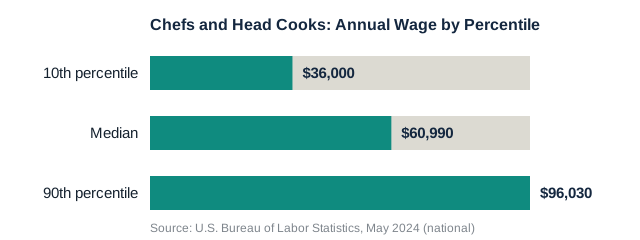
BLS tracks this occupation under the combined title "Chefs and Head Cooks," SOC code 35-1011, describing the work as overseeing the daily food preparation at restaurants and other places where food is served. The median annual wage was $60,990 in May 2024 ($29.32 an hour), above the $49,500 median across all occupations in the U.S. economy that year. The bottom 10% of chefs and head cooks earned less than $36,000, and the top 10% earned more than $96,030, a spread of well over two and a half times between the lower and upper bound BLS reports. For a healthcare role with a comparable median but a formal bachelor's-degree entry bar instead of years of food-service experience, see this site's clinical lab technologist pay guide.
That $60,990 median sits above the $44,140 BLS reports for supervisors of food preparation and serving workers, a related but more junior role, and it is worth separating from figures that circulate on general salary-aggregator sites, which BLS does not publish or verify. This page reports only the U.S. Bureau of Labor Statistics figures, sourced directly from BLS's own Occupational Employment and Wage Statistics survey of employer payroll data rather than self-reported submissions.
The entry path: little formal education, years of experience instead
BLS lists a high school diploma or equivalent as the typical entry-level education for chefs and head cooks, the same tier as several other occupations this site covers. What sets this occupation apart is the second line in BLS's Quick Facts box: work experience in a related occupation of five years or more, also listed as typical. BLS lists no additional on-the-job training beyond that, meaning the five years of prior experience is effectively doing the training. That combination, a low formal-education bar paired with a long experience requirement, is unusual; most high-school-diploma occupations BLS tracks list either no experience requirement or a much shorter one.
BLS describes two routes into that experience. Some chefs and head cooks attend a culinary program at a community college, technical school, culinary arts school, or four-year college before entering the field; others learn entirely through apprenticeship programs or by working their way up through food-service jobs. BLS does not describe either route as required, only as common paths people take toward the five years of related experience the occupation typically expects. That is a different model from bartending, a similarly education-light food-service occupation on this site where BLS lists no related-experience requirement at all, just a few weeks of on-the-job training after hire.
Where chef pay sits on the food-service ladder
BLS's Occupational Outlook Handbook page for chefs and head cooks lists two adjacent food-service occupations for direct comparison, both drawn from the same May 2024 wage survey. Food preparation workers, who BLS describes as performing tasks other than cooking, such as slicing meat and brewing coffee, require no formal educational credential and earned a median of $34,220, about $26,770 below the chef and head cook median. Food service managers, who oversee the daily operation of a restaurant or similar establishment, need only the same high school diploma BLS lists for chefs, yet earned a higher median of $65,310, about $4,320 above chefs and head cooks.
That places chefs and head cooks in the middle of a three-step ladder inside the same broad food-service field: a no-credential prep role below, a supervisory management role above, and the chef and head cook role itself sitting on five years of related experience rather than either a lower or a higher formal-education requirement. Measured against a different vocational field entirely, chefs and head cooks also out-earn welders, cutters, solderers, and brazers, who BLS lists at the same high-school-diploma entry tier but a median of $53,750, roughly $7,240 below chefs. BLS's data describes the pay at each tier; it does not explain why five years of food-service experience commands a premium over a shorter vocational-training route in a different industry, and this page does not assert a cause beyond what BLS itself reports.
Industry breakdown and job outlook
BLS breaks out May 2024 median pay for chefs and head cooks across four industry categories. Traveler accommodation, hotels and similar lodging that run their own kitchens, paid the highest median at $73,110. Amusement, gambling, and recreation industries followed at $69,430. Food services and drinking places, the industry employing the largest share of chefs and head cooks in traditional restaurants, paid $59,450, close to but below the national median. Healthcare and social assistance, covering institutional kitchens in hospitals and care facilities, paid the lowest of the four tracked industries at $57,350. At a much more credential-heavy tier, this site's genetic counselor pay figures show a $100,040 median for a master's-level role, well above any of the industry figures above.
BLS projects 7% employment growth for chefs and head cooks from 2024 to 2034, classified as much faster than the roughly 3% average projected across all occupations, adding an estimated 14,000 jobs to the 197,300 already employed in 2024. About 24,400 openings are projected each year on average over the decade, which BLS attributes mainly to the need to replace workers who transfer to other occupations or leave the labor force, rather than to net new job creation alone. BLS does not publish a stated explanation for the growth rate itself on this occupation's Handbook page the way it sometimes does for other roles. This site's audiologist salary guide covers a faster-growing clinical field, with BLS projecting 11% growth through 2035 against a $95,780 median.