U.S. salary & occupation data · BLS sourced Ser. 2026

Salary Guide SOC 53-2021

Air Traffic Controller Salary: BLS Pay by Percentile (2026)

BLS puts the median air traffic controller salary at $148,080 a year. See the full wage range by percentile, by employer, and the FAA age rules that shape it.

Last updated 2026-08-30 · Wage data: May 2025 (BLS)

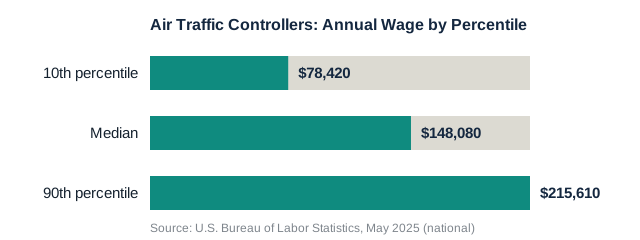
Bar chart showing air traffic controller annual wage by percentile: 10th percentile $78,420, median $148,080, 90th percentile $215,610, based on BLS May 2025 data.

Key figures

The median annual wage for air traffic controllers was $148,080 in May 2025, according to the U.S. Bureau of Labor Statistics, nearly three times the $50,980 median across all U.S. occupations that year. The bottom 10% earned less than $78,420, and the top 10% earned more than $215,610. Federal government employers, who employ the large majority of controllers, paid a median of $156,250, well above the $83,890 median for controllers working in air traffic support activities.

Air Traffic Controllers: Annual Wage by Percentile (May 2025, U.S. national)

10th percentile
$78,420
Median
$148,080
90th percentile
$215,610

Source: BLS Occupational Outlook Handbook: Air Traffic Controllers, May 2025.

Tool

See where your salary stands

Enter your own pay as a air traffic controllers, either annual or hourly, and this tool locates it against the BLS wage percentiles above.

Pay basis

BLS publishes a median hourly wage of $71.19 for this occupation; that real figure is used as the hourly reference. Your own hourly-to-annual conversion assumes 2,080 hours/year (BLS full-time convention).

Calculated client-side from BLS Occupational Outlook Handbook: Air Traffic Controllers, May 2025. Not personalized career, financial, or tax advice.

Industry (May 2025) Median annual wage
Federal government $156,250
Support activities for air transportation $83,890

Jobs (2025)

24,000

Outlook (2025-35)

2%

Employment change

+400

Typical entry education

Associate's degree

What air traffic controllers actually earn, by percentile

BLS tracks air traffic controller pay through its Occupational Employment and Wage Statistics (OEWS) program, which surveys employers directly and does not rely on self-reported figures. The most recent published data, from May 2025, put median annual pay at $148,080, or $71.19 an hour. That is nearly three times the $50,980 median BLS reports across all U.S. occupations for the same year, making air traffic control one of the highest-paying occupations tracked on this site.

The bottom 10% of air traffic controllers earned less than $78,420 in May 2025, while the top 10% earned more than $215,610. Even the bottom of that range sits above the median for most occupations on this site, including registered-nurse-adjacent and technologist roles that themselves require years of postsecondary training. The gap between the 10th percentile and the median, about $69,660, is close in dollar terms to the gap between the median and the 90th percentile, about $67,530, which is a comparatively even split. On this site's flight attendant salary guide, by contrast, the top half of the range stretches more than twice as far in dollar terms as the bottom half, a difference traceable to how each occupation's pay actually gets set.

Why the government pays so much more than everyone else

BLS breaks out May 2025 wages for air traffic controllers across two industry categories, fewer than it tracks for most occupations on this site, because the role is unusually concentrated in a single type of employer. Federal government employers, who run essentially all of the country's en route centers, terminal radar approach control facilities, and major airport towers, paid a median of $156,250. Controllers working in support activities for air transportation, a category that includes contract towers at smaller airports operated by FAA-approved private companies rather than the FAA itself, earned a median of $83,890, roughly half as much.

BLS does not explain the gap between the two categories on this page; it publishes the two medians without commentary. One plausible, unverified factor is that most air traffic controllers are federal employees paid under the FAA's own air traffic controller pay plan, a system separate from the General Schedule used by most federal civilian jobs, in which pay is tied to a facility's traffic complexity and to certification milestones a controller clears as they train up to full performance level, not simply to years of service. Contract-tower controllers, employed by private firms under FAA oversight rather than by the FAA directly, are not covered by that federal pay plan, which could account for some of the gap, but that is this article's inference, not a claim BLS itself makes.

Job outlook: growth is essentially flat

BLS projects employment of air traffic controllers to grow just 2% from 2025 to 2035, from 24,000 to 24,400 positions, a category BLS classifies as slower than the average for all occupations. That is a net increase of only 400 jobs over the entire decade. Despite that limited growth, BLS separately projects about 2,100 average annual openings for the occupation, because most openings come from replacing controllers who leave the role rather than from newly created positions.

The flat growth figure reflects how tightly the FAA controls hiring relative to a mostly fixed set of towers, centers, and approach facilities; it does not reflect declining demand for air travel. Almost all of the projected openings trace back to controllers reaching the FAA's mandatory retirement age, a structural feature unique to this occupation among the roles covered on this site.

Getting in: a narrower window than most careers, and how the pay compares

BLS lists an associate's degree as the typical entry-level education, but describes several paths in: an associate's or bachelor's degree completed through an FAA-approved Air Traffic Collegiate Training Initiative (AT-CTI) program, several years of progressively responsible work experience, or a combination of the two. Candidates must also be U.S. citizens and pass a medical evaluation, background check, and FAA preemployment testing, then complete training at the FAA Academy in Oklahoma City before being assigned to a facility as a developmental controller.

The entry window itself is unusually narrow. Under federal law (5 U.S.C. § 8335), operational controllers must generally separate from service by the end of the month in which they turn 56, and FAA hiring policy generally requires candidates to be appointed before their 31st birthday, with that cutoff extended to 35 for applicants with qualifying prior military or FAA-contract air traffic control experience. No other occupation covered on this site has both an age-based entry cutoff and a mandatory retirement age. This site's dental hygienist salary guide covers another associate's-degree occupation for comparison: dental hygienists earn a May 2024 median of $94,260, well below the controller median, with no equivalent age restriction on either end of a career. This site's flight attendant salary guide covers the other FAA-regulated occupation in this dataset; flight attendants need only a high school diploma to start, versus a controller's associate's degree and FAA Academy training, yet the top 10% of flight attendants still earn more than $136,430, above the $78,420 floor for the bottom 10% of controllers, since flight attendant pay keeps climbing with seniority for as long as the person keeps flying, with no age-based ceiling on the career itself.

Frequently asked questions

What is the median air traffic controller salary?

BLS's May 2025 figures put the median pay for people who direct air traffic at $148,080 a year, or $71.19 hourly, about three times the all-occupation median of $50,980 reported the same year.

Do air traffic controllers need a college degree?

Not necessarily. Per BLS, most people enter with a two-year degree, though the agency also describes alternate paths in: candidates can complete an AT-CTI program (the FAA's dedicated pathway for the role) at either the two-year or four-year level, or qualify instead through multiple years of hands-on, increasingly senior work in a related field, then clear the FAA's preemployment screening and finish the required coursework at the FAA Academy.

Why do federal air traffic controllers earn so much more than others in the field?

BLS reports a May 2025 median of $156,250 for federally employed controllers, versus $83,890 for those at FAA-approved contract towers, categorized under air-transportation support roles. The BLS page does not explain why the two medians differ. A likely, though unconfirmed, explanation is that federal controllers fall under a pay plan the FAA maintains specifically for this occupation, tied to how busy and complex a given facility is, and how far a controller has advanced through the certification process, which contract-tower employees working for private firms are not covered by. BLS never states this as the reason; it is this page's own reading of how the two pay systems differ.

Is there an age limit to become an air traffic controller?

Yes. New hires generally must join before turning 31, per FAA hiring policy, though that ceiling rises to 35 for those who already have relevant active-duty or contract-tower experience directing air traffic. A separate rule, 5 U.S.C. § 8335, requires controllers in operational roles to leave the job once they hit 56, generally at that month's end.

Is air traffic control a growing occupation?

No, not by much. BLS projects only a 2% rise in controller employment between 2025 and 2035, well below the pace of most other occupations, adding a net 400 jobs. Still, BLS expects roughly 2,100 openings a year on average, with almost all of them stemming from people aging out of the role at the mandatory cutoff, not from expansion of the workforce.

How long does it take to become an air traffic controller?

There is no single fixed number. Per BLS, candidates typically hold at least a two- or four-year degree earned via the FAA's AT-CTI collegiate program, or build a comparable multi-year track record of increasingly senior work instead, then clear FAA's medical screening, background review, and preemployment exams before completing a training course at the FAA Academy. Once hired, BLS states that new controllers typically complete more than 12 months of additional on-the-job training before working independently.

Why do air traffic controllers have to be hired before age 31?

The 31 cutoff pairs with the mandatory-retirement side of the career: 5 U.S.C. § 8335 sets the outer limit at age 56 for operational staff. Hiring candidates before 31 leaves at least 25 years to complete the lengthy training pipeline, from AT-CTI coursework, through instruction at the FAA Academy, and more than 12 months of on-the-job certification at an assigned facility, and still spend a substantial career actually working traffic before having to step aside at the mandatory cutoff. BLS does not itself explain the policy rationale; that reasoning is this page's inference from how the entry cutoff and the age-56 exit rule line up, not a specific justification BLS states on its occupational page. The ceiling rises to 35 for candidates who already have qualifying active-duty or contract-tower air traffic experience, since that background shortens the training runway needed before retirement.

Cite this

WageLark Editorial, “Air Traffic Controller Salary: BLS Pay by Percentile (2026),” WageLark, published August 9, 2026, https://wagelark.com/air-traffic-controller-salary/.

This page reports government wage statistics for informational purposes. It is not personalized career, financial, or legal advice, and does not endorse or recommend any specific employer, school, or training program.

Response card

Did these figures answer your question?

Written and edited by the WageLark Editorial Team