U.S. salary & occupation data · BLS sourced Ser. 2026

Career Guide SOC 51-4121

What Does a Welder Do? Duties, Safety, and BLS Pay Data

Welders read blueprints, then join or cut metal by hand under intense heat and light. BLS's median pay for the role is $53,750, with real burn and injury risk.

Last updated 2026-09-23 · Wage data: May 2025 (BLS)

Diagram showing four things welders do per BLS: read blueprints and specifications, measure and inspect materials, weld or cut according to spec while monitoring heat, and maintain their equipment.

Key figures

Per the U.S. Bureau of Labor Statistics, welders, cutters, solderers, and brazers use hand-held or remotely controlled equipment to join, repair, or cut metal parts, reading blueprints, measuring dimensions, and monitoring heat as they work. BLS tracks the four roles under one SOC code, 51-4121, and reports a median annual wage of $53,750 in May 2025. The work carries real physical risk: BLS specifically flags fumes, very hot materials, and intense arc light among the job's hazards, and most workers need only a high school diploma plus technical and on-the-job training to enter.

Welders, Cutters, Solderers, and Brazers: Annual Wage by Percentile (May 2025, U.S. national)

10th percentile
$39,240
Median
$53,750
90th percentile
$77,530

Source: BLS Occupational Outlook Handbook: Welders, Cutters, Solderers, and Brazers (data from May 2025, synced 2026-09-23, superseding the May 2024 figures cited when related pages were first published), May 2025.

Tool

See where your salary stands

Enter your own pay as a welders, cutters, solderers, and brazers, either annual or hourly, and this tool locates it against the BLS wage percentiles above.

Pay basis

BLS publishes a median hourly wage of $25.84 for this occupation; that real figure is used as the hourly reference. Your own hourly-to-annual conversion assumes 2,080 hours/year (BLS full-time convention).

Calculated client-side from BLS Occupational Outlook Handbook: Welders, Cutters, Solderers, and Brazers (data from May 2025, synced 2026-09-23, superseding the May 2024 figures cited when related pages were first published), May 2025. Not personalized career, financial, or tax advice.

Industry (May 2025) Median annual wage
Specialty trade contractors $59,440
Repair and maintenance $56,080
Manufacturing $51,210

Jobs (2025)

437,700

Outlook (2025-35)

2%

Employment change

+10,300

Typical entry education

High school diploma or equivalent

What welders actually do, per BLS

Per BLS, welders, cutters, solderers, and brazers "typically do the following": read and interpret blueprints, sketches, and specifications; calculate and measure the dimensions of parts to be welded; inspect structures or materials to be welded; weld materials according to blueprint specifications; monitor the welding process and adjust heat as necessary; and maintain equipment and machinery. BLS describes the core of the work as using hand-held or remotely controlled equipment to join or cut metal parts, and notes workers in this occupation also fill holes, indentations, or seams in metal products.

Some workers specialize in a single technique; others perform several. BLS also notes that welders usually choose which process to use based on a number of factors, such as the types of metals being joined, which means the same worker's daily tasks can shift from job to job even within one specialty.
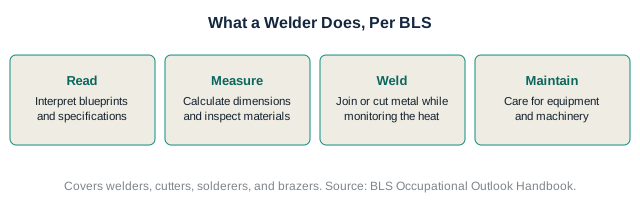
Diagram showing four things welders do per BLS: read blueprints and specifications, measure and inspect materials, weld or cut according to spec while monitoring heat, and maintain their equipment.

Four roles, one SOC code: how the techniques differ

BLS groups four distinct job titles under the same 51-4121 classification, and distinguishes them by technique rather than by pay. Welders join metals using processes such as arc welding, in which machinery produces an electrical current that generates heat to bond pieces together. Cutters use heat from an electric arc, a stream of ionized gas called plasma, or burning gases to cut and trim metal objects to specific dimensions, a role that also covers dismantling large structures such as ships, railroad cars, and buildings.

Solderers and brazers both heat molten filler metal to join two or more metal objects, but the two differ by temperature and application. Soldering uses a lower melting temperature and is common on small, precisely positioned pieces, such as computer chips. Brazing connects dissimilar metals through a filler material, which BLS says creates strong joints in products built from multiple metal types, and brazers may also apply protective coatings to parts to reduce wear and guard against corrosion. BLS does not publish separate wage data for any of the four titles individually; the $53,750 median below covers all four combined.

Where and how they work: heat, heights, and hazards

BLS describes welders and cutters as wearing protective clothing and welding helmets for safety, a detail it flags directly on the occupational summary rather than burying in a footnote. Work may happen outdoors in all types of weather or indoors, sometimes in a confined area designed to contain sparks and glare, and some jobs require working on a scaffold or platform high off the ground. BLS also notes workers may need to lift heavy objects and work in awkward positions, including overhead, while bending, stooping, or standing.

Under a section BLS titles "Injuries and Illnesses," the agency states plainly that welders, cutters, solderers, and brazers risk injury on the job, citing exposure to fumes, very hot materials, and the intense light created by the arc as specific hazards. BLS says workers avoid injuries by following safety procedures and using personal protective equipment, including welding helmets, hearing protection, and heat-resistant gloves. Separately, this site's welder salary guide reports that OSHA requires welders to complete training on electrical safety specifically, on top of whatever general safety procedures an individual employer follows.

Most welders, cutters, solderers, and brazers work full time, and some work more than 40 hours a week, per BLS. Many manufacturing firms run two or three shifts a day, each 8 to 12 hours, to keep production going around the clock, which means evening and weekend work is common in this occupation even outside of overtime.

Pay and outlook at a glance

BLS reports a median annual wage of $53,750 for welders, cutters, solderers, and brazers in May 2025 ($25.84 an hour), with the bottom 10% earning less than $39,240 and the top 10% earning more than $77,530. Manufacturing employs the largest share of the occupation at 61%, though it pays the lowest of the three industry medians BLS tracks, behind specialty trade contractors and repair and maintenance. BLS projects 2% employment growth from 2025 to 2035, slower than the roughly 3% average across all occupations, though about 40,300 openings are still projected each year, mostly from workers leaving the occupation rather than newly created positions. For the full percentile breakdown, covering the industry pay table and an entry-path comparison against other no-degree trades such as electricians and plumbers, pipefitters, and steamfitters, see this site's welder pay page.

Per BLS, welders typically need only a high school diploma or equivalent, combined with technical and on-the-job training, to enter the occupation, with no postsecondary degree required. That distinguishes the entry path from several other skilled trades this site tracks, which more often run through a multi-year formal apprenticeship before a worker reaches full pay. What a millwright does, for example, is covered on its own page with duties, path, and BLS pay data.

Frequently asked questions

What does a welder do on a typical day?

Per BLS, a welder's day runs through studying job specs and drawings, checking over the pieces before joining them, running the actual weld while keeping heat under control, then cleaning and maintaining the equipment afterward. The choice of process, arc welding among them, usually comes down to factors like which metals are being joined.

What's the difference between a welder, cutter, solderer, and brazer?

BLS tracks all four together in its data, sorting them apart by what each one physically does rather than any pay distinction. Welders bond metal through methods like arc welding, running a current through the joint to generate melting heat. Cutters rely on an electric arc, plasma, or an open flame to slice and shape metal pieces, including taking apart large structures. The other two share a filler-metal approach, fusing pieces with heated filler rather than melting the base metal itself, but at different temperatures and for different jobs. Soldering runs cooler and suits small, precise work, while brazing works across metals of different types and can leave behind a wear-resistant coating.

Is welding a dangerous job?

BLS is direct about it: this occupation carries real injury risk, pointing to airborne fumes, extreme heat, and the arc's blinding glare as job-specific risks. The countermeasures are procedural and physical: sticking to safety protocols and wearing gear like a welding helmet, ear protection, and gloves rated for heat. Some assignments also add work at height, heavy lifting, or twisting into cramped body positions to the mix.

How much do welders make?

For May 2025, BLS puts pay at a $53,750 median annually, or $25.84 an hour, ranging from under $39,240 at the 10th percentile up to $77,530 at the 90th. That spread, plus a breakdown by industry, lives on this site's dedicated wage guide for the role.

Do welders work regular hours?

Most are on full-time schedules, with some clocking over 40 hours a week, according to BLS. A lot of manufacturing plants run 8- to 12-hour shifts, two or three per day, so the line never really stops, and evenings and weekends come with the territory even before counting overtime.

Do welders make a lot of money?

Not especially, relative to the broader U.S. labor market. BLS's May 2025 figure for this occupation, $53,750, sits just above the $50,980 median it reports economy-wide for that same year. See this site's welder pay breakdown for the complete wage-by-percentile and industry picture.

Is welding a hard job?

Physically and technically, yes, on the demands BLS itself describes. The work calls for close, sustained attention (adjusting heat on the fly while working to spec), real physical strain (hauling heavy pieces, reaching overhead or twisting into cramped postures, sometimes working at height on temporary rigging), and genuine on-the-job hazards from smoke, punishing heat, and the arc's own glare. Add in round-the-clock manufacturing shift patterns, and evening or weekend work becomes routine rather than an exception. It's a skilled trade with a relatively fast, low-cost entry path, but BLS's own description of the job doesn't paint it as easy once someone is actually doing it.

Why do welders not live long?

BLS doesn't publish life-expectancy or mortality data for any occupation, and this page isn't aware of a rigorous, welder-specific study that puts a number on it. What is well documented is the occupational exposure behind that reputation. Welding fume particles small enough to reach deep into the lungs can cause fibrosis, or scarring, that can develop into lung cancer, and welding on stainless steel and other chromium-containing alloys can expose workers to hexavalent chromium, which OSHA identifies as carcinogenic and linked to effects on the respiratory system, kidneys, liver, skin, and eyes. Manganese in welding fume has also been linked to neurological damage at low exposure levels. Modern fume-extraction equipment and respiratory protection substantially cut down these exposures versus unprotected work, and safety gear plus following protocol is how BLS says the occupation's injury risk gets managed day to day, but the underlying health hazards are real and specific, not just a reputation.

Can you make $100,000 as a welder?

Not typically, per national BLS data. The 90th-percentile figure BLS publishes for the combined group, $77,530 in May 2025, is the highest bracket it reports, well short of $100,000. Reaching that level would generally mean combining top-decile pay with a higher-paying specialty, employer, or region than the national wage data captures; see this site's welder wage guide for the fuller breakdown.

Cite this

WageLark Editorial, “What Does a Welder Do? Duties, Safety, and BLS Pay Data,” WageLark, published August 25, 2026, https://wagelark.com/what-does-a-welder-do/.

This page reports government wage statistics for informational purposes. It is not personalized career, financial, or legal advice, and does not endorse or recommend any specific employer, school, or training program.

Response card

Did these figures answer your question?

Written and edited by the WageLark Editorial Team